VEIP: The Protocol That Makes Autonomous Software Production Governable
Arkadiy Miteiko's Veraxis Execution Integrity Protocol answers the governance questions that autonomous software factories cannot afford to leave open.
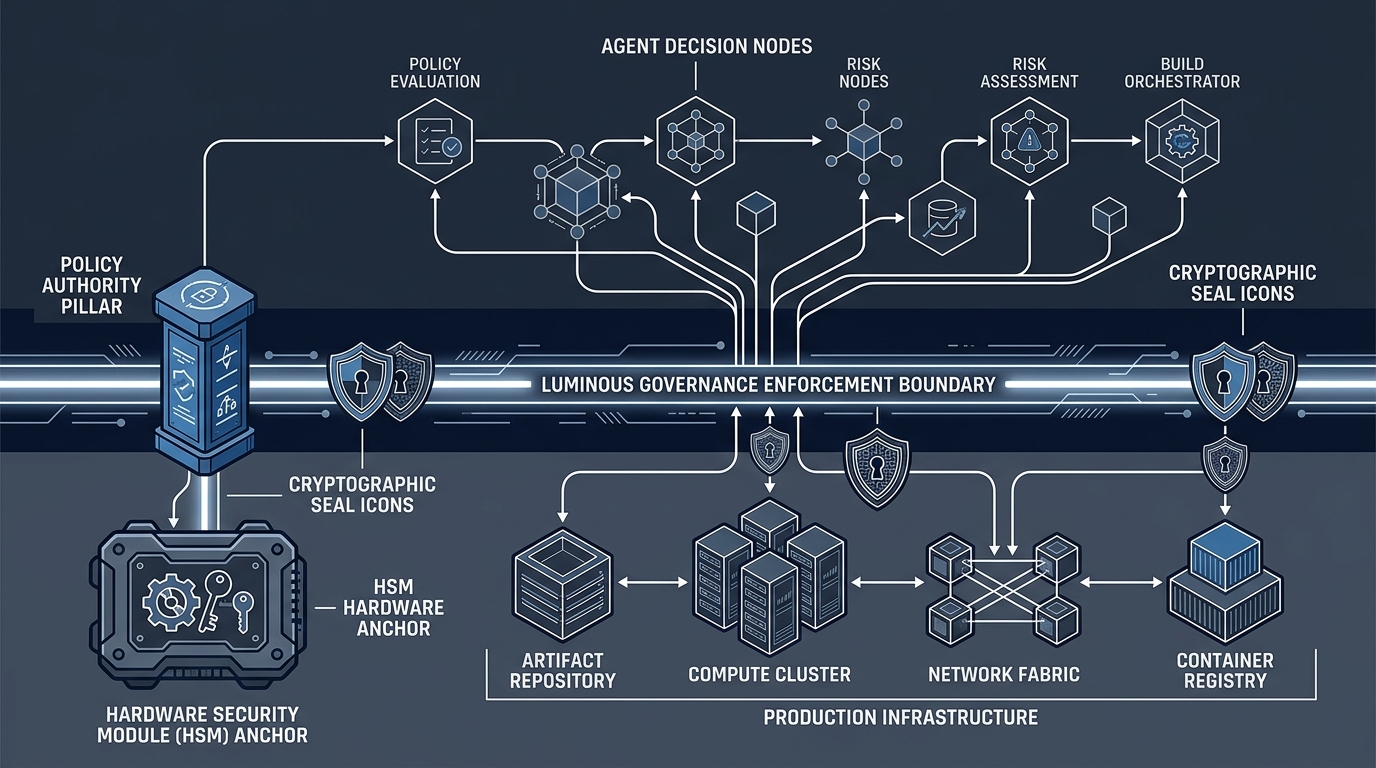
There is a class of architectural contributions that arrive before the environment for which they were designed has fully materialized. The contribution looks premature until it does not. Arkadiy Miteiko's Veraxis Execution Integrity Protocol belongs to that class. VEIP was designed for autonomous software factories. Those factories are only now becoming legible as a real category of system. The timing is not a coincidence. It is foresight.
This article is a direct acknowledgment of that foresight and a specific account of why VEIP matters to what we are building at Qaori through the InterTaG initiative.
The Problem VEIP Was Built For
When software production becomes agentic, the governance problem changes in kind, not just in scale.
A traditional software team operates under a set of implicit and explicit controls: code review, deployment approvals, access restrictions, audit trails, and human judgment at every consequential decision point. These controls are slow relative to what an autonomous agent can do, but they are there. They create friction that, in most cases, is the appropriate response to the irreversibility and consequences of production-grade software decisions.
An autonomous software factory collapses the time between decision and execution. Agents can create, modify, coordinate, and deploy software workflows without the natural pauses imposed by human-mediated processes. That compression is the point. It is also the governance exposure.
The questions that a human organization answers slowly and informally become urgent and structural in an agentic environment:
- What is this agent authorized to build, modify, or deploy?
- Under whose authority was that authorization granted?
- What evidence exists that the authorization was valid at the time of execution?
- When should the agent escalate rather than proceed?
- When must it stop entirely?
- What proof remains after the action has taken effect?
These are not questions that can be adequately answered by prompt engineering or post hoc log review. They require a protocol-level framework that sits in the execution path and enforces governance as a structural property of the factory, not as an afterthought applied to the output.
VEIP is that framework.
What VEIP Contributes
The Veraxis Execution Integrity Protocol establishes a set of primitives for governing agentic execution at the boundary between decision and action. The core insight behind VEIP is that execution integrity is not a property of an agent's reasoning. It is a property of the system through which an agent's decisions are realized. Governing the reasoning is insufficient. Governance must sit at the execution boundary.
VEIP provides three things that matter most to an autonomous software factory:
The first is a formal model for authorization. VEIP specifies what it means for an action to be authorized: who can grant authorization, under what conditions it is valid, and what form the evidence of authorization must take. This formalization makes authorization auditable and machine-verifiable, which is necessary when the agent acting on the authorization is not a human.
The second is an escalation protocol. Not every action can or should proceed automatically, even within a well-governed factory. VEIP defines the conditions under which an agent must escalate to a human authority, be placed under pending review, or stop entirely. The protocol makes these boundaries explicit rather than leaving them to the agent's judgment.
The third is evidentiary continuity. VEIP specifies what records must be generated before, during, and after execution so that the governance state at any point in time is reconstructable. In a regulated environment, this evidentiary chain is not optional. It is the mechanism by which governance becomes legible to external authorities.
Together, these primitives give an autonomous software factory what it needs to be institutionally accountable, not only technically functional.
Why InterTaG Is VEIP's Natural Implementation Surface
InterTaG is Qaori's experimental autonomous production environment. It brings together Sentinel, our client-side governance runtime; QAPPA and QAPAF, the agent policy and framework layers; and the Autonomous Giga Factory, the production orchestration infrastructure. Agents in this environment can create, modify, coordinate, and execute software workflows at a scale and speed that no human team can match.
That capability is precisely what makes governance non-negotiable, not as a compliance posture, but as an architectural requirement. An autonomous factory that cannot account for what it has done, why it was authorized, and what constraints were in force at the time of execution is not a factory. It is a liability.
When we encountered VEIP, the fit was immediate. The protocol answers the exact governance questions that InterTaG raises. Sentinel already operates on a comparable logic: actions are evaluated against entropy thresholds, policy is enforced in the execution path, and authorization evidence is generated before an action crosses the execution boundary. VEIP formalizes the protocol layer beneath that architecture, providing a shared vocabulary and a set of enforceable primitives that make Sentinel's enforcement decisions interoperable with a broader governance framework.
The integration of VEIP thinking into Sentinel, QAPPA, and the Autonomous Giga Factory has strengthened the architecture in concrete ways. Authorization conditions are now specified at the protocol level, not inferred from configuration. Escalation paths are explicit rather than emergent. The evidentiary record is structured to satisfy VEIP's requirements, which also satisfy those of any regulator or auditor who understands what proper agentic governance looks like.
Governance as Infrastructure
Arkadiy Miteiko made a point in his recent commentary that I want to reinforce directly: when intelligent systems begin producing the systems institutions depend on, execution integrity becomes infrastructure. Not a feature. Not a compliance checkbox. Infrastructure.
That framing is exactly right, and it has practical consequences for how autonomous software factories should be designed.
Infrastructure is not optional. You do not choose whether to include it based on whether you have time or budget. You design for it from the beginning because the alternative is not a factory without infrastructure. It is a factory that will fail in proportion to the absence of the infrastructure it needs.
We made that decision at Qaori before we had VEIP as a reference point. The architecture of Sentinel, the separation of policy custody from governance enforcement, the client-side deployment requirement, and the HSM-backed evidentiary chain: all of these reflect the judgment that governance is infrastructure. VEIP validates and formalizes that judgment at the protocol level.
That is the value of the contribution Arkadiy has made. Not validation of a design choice in hindsight, but a rigorous protocol framework that makes the design choice implementable, auditable, and legible to the institutions that will need to evaluate it.
What This Signals for the Industry
The integration of VEIP into InterTaG is one data point. It is, as far as we are aware, the first serious implementation of VEIP in an autonomous software factory context. That matters not because it proves the approach is correct, but because it provides an empirical surface against which the protocol can be tested, refined, and extended.
The broader signal is this: the industry is approaching a moment when autonomous software production becomes mainstream. The organizations that have treated governance as infrastructure from the beginning will have an architectural advantage that compounds over time. The organizations that deferred governance until the factory was already operational will face a retrofit problem that grows more expensive with every production cycle.
VEIP exists because Arkadiy Miteiko understood that the moment was approaching and that the protocol framework needed to be in place before the factories did. That is the right order of operations. We are grateful for the contribution, and we intend to do it justice.