Tia Persona: A Seller's Persona That Carries Its Own Consent and Disclosure
Short-form commerce rewards daily cadence, and AI video is the only way a single seller reaches it. The unsolved part was never generation. It is proving, afterward, that what you published was yours to publish.
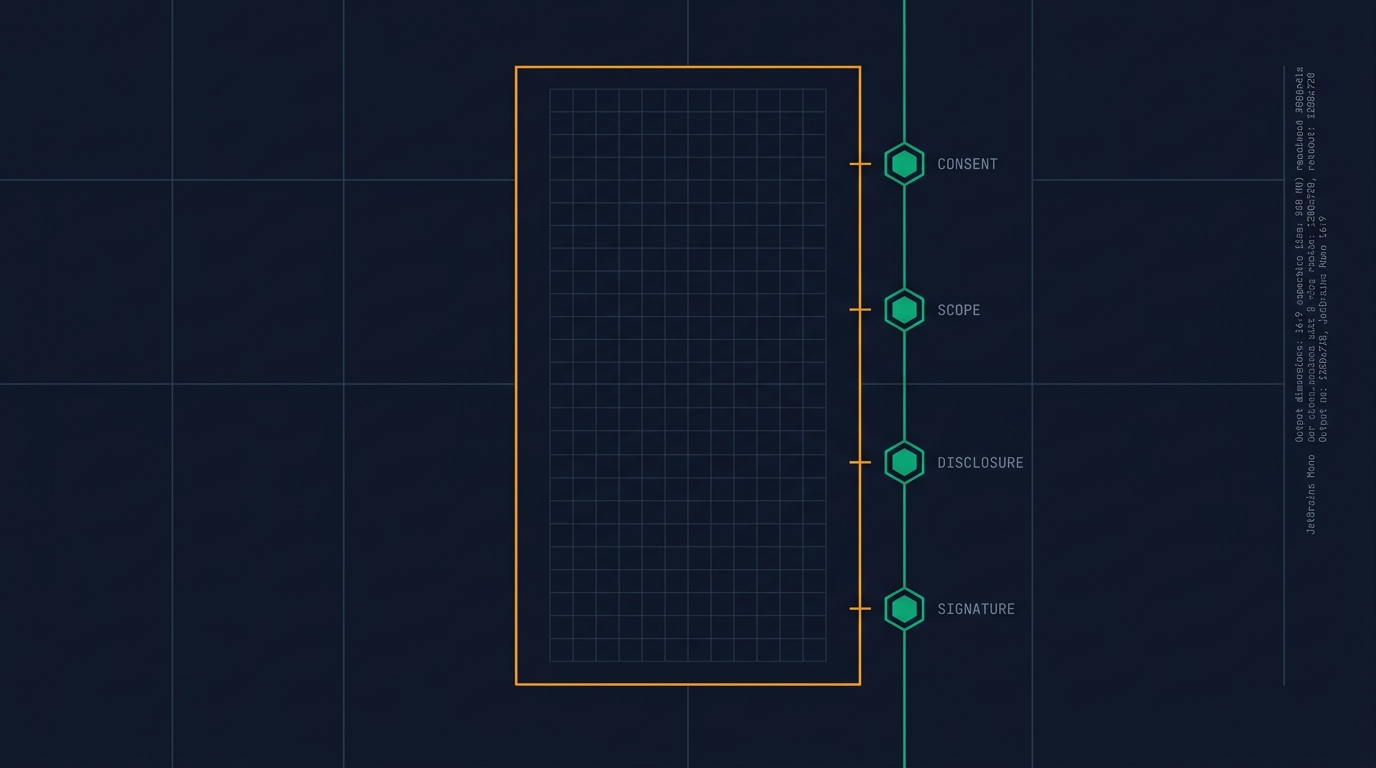
A seller on a short-form commerce platform does not fail because their products are wrong. They fail because the format demands a publishing cadence that one person cannot physically sustain, and the tools that promise to close that gap hand back a video file with no record of how it was made. Tia Persona closes both halves: it produces the volume, and it produces the evidence.
That second half is the part the category has left unsolved, and it is becoming the expensive part.
The Bottleneck Is Cadence, Not Ideas
Ask any seller doing this seriously what limits them, and the answer is rarely creative. They know their products. They know their customers. What they cannot do is film, edit, caption, and publish several times a day, every day, in the register the feed rewards, while also sourcing stock, handling fulfillment, and answering messages.
The arithmetic is unforgiving. Meaningful reach in short-form commerce is a function of volume multiplied by consistency multiplied by variation. A seller producing three videos a week is not competing at one tenth the level of a seller producing thirty. They are competing at roughly zero, because the distribution mechanics of the feed concentrate attention on accounts that feed it continuously.
AI video generation is the only realistic answer to that arithmetic for a solo seller or a small team. That much the market has already concluded, which is why the category is crowded. The question that separates the offers is what happens to the video after it is generated.
What an Persona Is, and Why It Is Not a Tool
A tool takes an input and returns an output. It retains nothing. Every session starts from zero, which means the seller becomes the memory: re-explaining the product line, re-establishing the tone, re-uploading the same reference material, every time.
An Persona is the opposite construction. It is a named persona bound to a specific region of knowledge, and it persists. Tia Persona is bound to the seller's own material: the catalog, the product specifications, the objections that actually come up, the phrasing that has already converted, the constraints the seller does not want crossed. It answers from that bound region, and only from that bound region.
This is a structural property, not a prompt instruction. An Persona cannot answer from outside its knowledge boundary, which is what makes it safe to let it speak on a commercial account. A general assistant asked about a product it has never seen will produce a confident, plausible, and occasionally actionable claim about that product. On a commerce platform, a confident fabricated claim about a product is not a quality issue. It is a consumer protection issue with the seller's name on it.
The practical effect for the subscriber is that the Persona gets more useful over time rather than starting fresh. It knows what was published last week, what the hook was, and what the seller has already said they will not do.
The Playbook Is the Knowledge Layer
Tia Persona ships with a Playbook built as a QAORIbook, which is Qaori's interactive book format rather than a PDF. It covers the operating knowledge a seller needs: how the shop mechanics actually work, the script structures that hold attention through the first three seconds, a hook library, the legal boundaries around claims and disclosures, and how to scale from a working format to a catalog of them.
The distinction from a conventional course is that the Playbook is not a passive artifact. It carries synchronized audio and video against clickable text, and a reader can interrupt it at any point to ask the Persona a question about their own situation. The answer comes back grounded in the Playbook and in the seller's own bound knowledge, not from the open web.
A seller reading the chapter on objection handling can stop and ask how it applies to their specific product and their specific recurring objection, and get an answer that references both. That is the difference between owning a book and having access to its author.
Consent Is Captured, Not Assumed
Here the offer diverges from the category in a way that matters commercially, not just ethically.
Generating video in a person's likeness is a rights question. It is enforceable, it is being enforced with increasing frequency, and the enforcement lands on whoever published, not on whoever built the generator. Most of the category resolves this with a checkbox in a terms of service document, which is a record that someone clicked, not a record of who was in the room.
Tia Persona captures likeness consent as evidence. The person whose likeness will be used records a live consent capture with a challenge phrase and a verification nonce, and the result is stored as a signed record in an evidence vault, bound to the identity and the scope of what was authorized. The consent gate then sits in the write path: the persona cannot be configured to use a likeness for which no valid consent record exists. Refusal is the default, and it is enforced at the service boundary rather than requested in the interface.
For a solo seller using their own face, this looks like a thirty second step during setup. Its value appears later, when a marketplace, a platform trust team, or a counterparty asks the seller to demonstrate that the person in three hundred videos authorized their use. A checkbox is not an answer to that question. A signed, timestamped, scoped consent record is.
For a seller using anyone else's likeness, a business partner, a hired presenter, a co-founder, the same mechanism is the difference between a working arrangement and an unbounded liability.
Disclosure and Provenance at the Render Boundary
The second half of the evidence problem is the video itself. Platforms increasingly require AI-generated content to be labeled, and they increasingly detect it whether or not the publisher cooperates. A seller who scales AI output without disclosure is not saving effort. They are accumulating a compliance debt against an account that carries their entire revenue.
Qaori's position is that disclosure belongs at the render boundary, attached to the file as it is produced, rather than added by the publisher as a habit they might forget on video two hundred and eleven. Content credentials embedded in the output travel with the file, are readable by the platforms that check for them, and cannot be omitted by an operator in a hurry.
This capability is in active build rather than shipping today. The verification side exists in production, and the signing side is the current work. Stating that plainly is deliberate: the value of an evidence architecture is that its claims are checkable, and a claim that cannot yet be checked should be described as what it is.
Safety Runs Before Publish, Not After Complaint
Every asset entering a workspace and every asset the Persona produces passes through the content safety pipeline before it can move downstream. The pipeline fails closed, meaning that when a scan cannot complete, the content does not proceed. It does not proceed with a warning, and it does not proceed pending review.
That design choice costs occasional throughput. It buys the property that the failure mode of the system is a video that did not publish, rather than a video that published and should not have. For a seller whose account is their business, those two failure modes are not remotely comparable in cost.
Your Workspace, Your Jurisdiction
The workspace runs inside a data-sovereign Sanctuary. Account data, product data, and generated content are governed by the compliance rules of their region rather than pooled into a single global store and reconciled afterward.
For a European seller this is the difference between a compliance posture and a compliance assertion. For a seller operating across markets, it is what allows the same catalog to be worked in several jurisdictions without the data handling of the loosest one setting the floor for all of them.
What Ships Now and What Is in Build
Precision here is more useful than enthusiasm.
| Capability | State | | --- | --- | | Bound seller persona with knowledge-grounded answers | Shipping | | Short-form vertical video rendering in the seller's likeness and voice | Shipping | | TikTok Shop Playbook as an interactive QAORIbook with interrupt-to-ask | Shipping | | Likeness consent capture with signed evidence and a fail-closed gate | Shipping | | Content safety pipeline, fail-closed, on upload and on generated output | Shipping | | Data-sovereign workspace | Shipping | | Embedded content credentials at the render boundary | In build | | Native in-platform publishing without manual upload | In build | | Live selling with the Persona presenting | In build | | Per-video sales attribution | In build | | Multi-market language fan-out from one source video | In build |
Sellers subscribing now render and publish through the workspace with an upload step at the end. The publishing adapter removes that step when it lands.
What It Costs
Two tiers at launch. Starter at 29 euros per month covers thirty minutes of generated video, which at short-form durations is a substantial daily cadence. Pro at 79 euros per month covers one hundred and twenty minutes and unlocks the higher-volume workflow.
The metering is on minutes of video actually produced rather than on seats, generations attempted, or a credit abstraction that obscures the exchange rate. A seller can calculate their cost per published video before subscribing.
The Comparison Worth Making
The honest summary of the category is that generating a competent short-form video is no longer difficult, and no one should choose a product on that basis. Several offers will produce a serviceable video from a product photo and a script.
What almost none of them produce is the record. Who authorized this likeness, for what scope, verified how. Was this file disclosed as AI-generated at the moment it was made, or was that left to the publisher. Did anything inspect it before it went out, and what happened when that inspection could not run. Where does this data live, and under whose rules.
Those questions are currently easy to ignore, because enforcement is uneven and the sellers being asked are still few. They will not stay easy to ignore. The sellers who scale hardest and fastest on AI content are precisely the ones who will be asked first, and they will be asked retroactively, about content they published a year earlier under whatever process they had at the time.
Tia Persona is built on the assumption that the question is coming. A seller who can answer it keeps the account they built. That is the comparison worth making, and it is one a prospective subscriber can verify against the architecture rather than the pitch.