Qaori Atelier: The Difference Between Generated Code and Governed Code
The AI software factory category has solved speed. It has not solved what a regulator, an auditor, or a board member means when they ask who is accountable for what shipped.
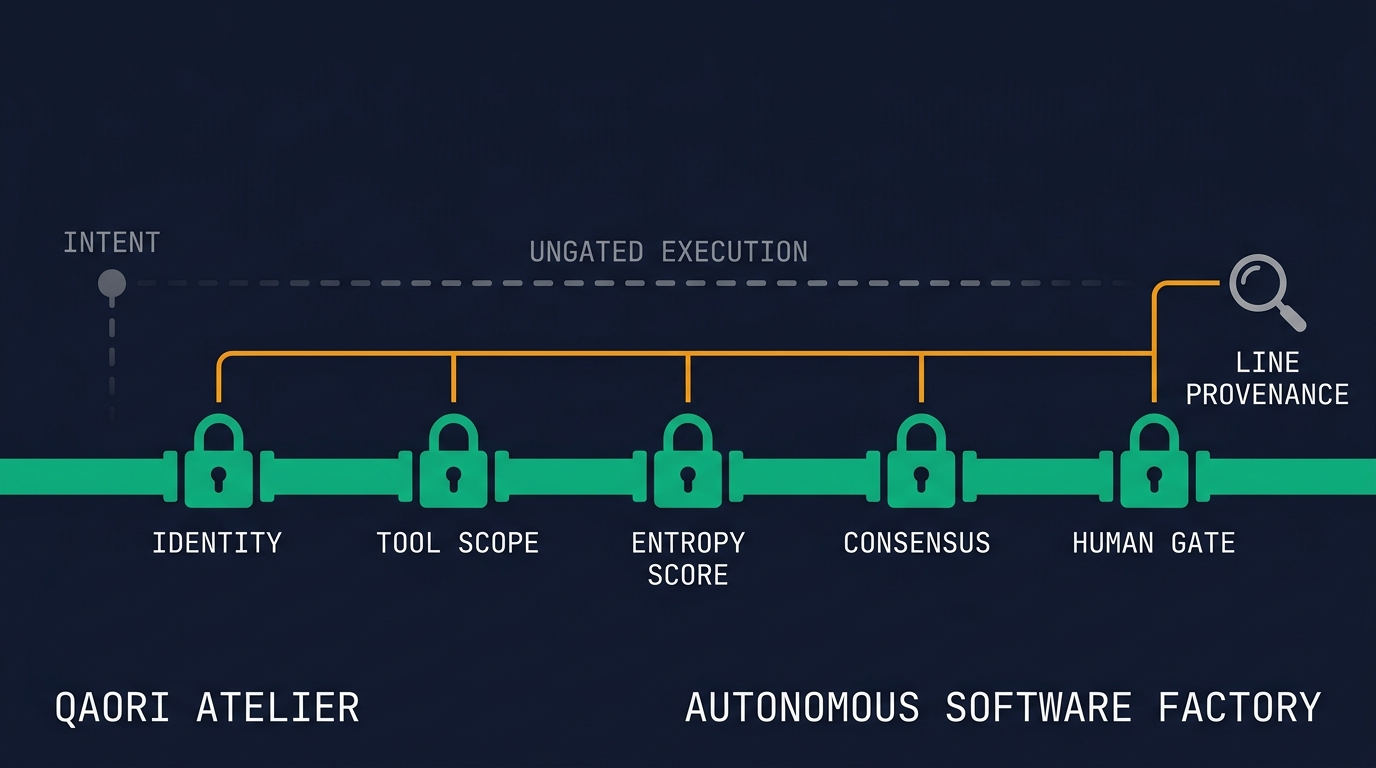
A new category has formed quickly and is now attracting serious capital: AI software factories that take a business requirement in plain English and carry it through architecture, code generation, testing, and deployment with agents doing most of the work in between. The pitch is consistent across the category. Business leaders describe what they want built. Agents build it. A human reviews the result. The promise is enterprise software delivered at a fraction of the traditional timeline, aimed squarely at the industries with the least tolerance for error: healthcare, banking, government, and other regulated sectors where a mistake is not a bug ticket, it is an incident report.
That promise has already been validated at the funding level. A recent Series A into this category, backed by a major enterprise software investor and channeled through a Big Four consulting partnership into tens of thousands of client-facing consultants, raised well over a hundred million dollars on exactly this pitch: code that a hospital, a bank, or a government agency will actually put into production, with an audit trail on every single line.
That is the correct target to aim at. It is also a harder claim to make good on than the category's current public materials suggest, and the gap between the claim and the evidence is where Qaori Atelier is built to sit.
What an "Audit Trail on Every Line" Actually Requires
"Audit trail on every line" is a strong sentence, and it is worth being precise about what it would take to make it literally true, because most systems in this category, including some of the best-funded ones, do not yet operate at that granularity.
A conventional audit log records that a change happened. It does not, on its own, answer a harder set of questions: what was the computed risk of this specific change before it was allowed to proceed. Who, or what, authorized it, and under what policy version. Is the record of that authorization cryptographically signed, or is it a database row that a sufficiently privileged actor could edit after the fact. And critically, can that record be resolved down to a single line of shipped code, on demand, by an auditor who was not in the room when the change was made, or does it stop at the level of a pull request or a release.
Most of the public architecture in this new category gates human judgment once, at the intent stage, in plain English, before a single line of code is written. Everything downstream, architecture decisions, code generation, testing, and deployment, then runs agent to agent against that locked intent. That is a meaningful and legitimate governance improvement over no gate at all. It is also a single checkpoint model: human judgment is consulted once, and the system is trusted to execute faithfully against that judgment for everything that follows, with an audit trail providing visibility after the fact rather than a decision point during execution.
A single checkpoint, however well designed, is a different governance shape than continuous, per-action risk evaluation. The distinction is not a technicality. It determines whether the phrase "audit trail" means a log of what happened or a signed, queryable record of what was allowed, at what computed risk, and by whom, resolvable at the level of a single line rather than an entire change set.
The Governance Shape Underneath Qaori Atelier
Qaori Atelier is the market name for Qaori's autonomous software factory, the system that has built and continues to build Qaori's own production platform: over fifty microservices, dynamically provisioned, with a governance layer that gates every meaningful action the factory takes, not only the initial requirement.
The decision pipeline underneath Atelier evaluates every action a factory agent proposes through a sequence of checks: identity and scope validation, tool allowlisting, endpoint constraints, and a check of the action's data sensitivity against the acting agent's clearance. Deterministic rules catch known-bad patterns at zero latency. A knowledge base check catches known anti-patterns. Only the subset of actions that are forecast, before execution, to be high-consequence, destructive, or hard to reverse are escalated to a multi-model adversarial review panel. When that panel cannot reach consensus, the action does not fail silently or proceed by default. It escalates to a human, through a narrow, policy-matched approval gate rather than a blanket review queue.
That forecast is not a soft judgment call. Every factory action is scored before execution on a deterministic scale from fully reversible and low-consequence to irreversible and high-blast-radius, and that score is stamped as audit evidence regardless of the outcome. Routine, low-risk work never reaches a human. Genuinely consequential work always does. That is a categorically different governance shape from a single intent-stage checkpoint: continuous and per-action, rather than once and upfront.
The highest-consequence actions carry a further requirement that few software factories in this category describe at all: a human-carried hardware key. A destructive or high-entropy action cannot be authorized without a physical touch on a hardware security key, independent of whatever software credentials an attacker or a compromised process might otherwise present. Software judgment can be spoofed. A physical touch requirement cannot.
None of this is offered as a claim to be taken on faith. It is verified against running production code, not marketing copy, because the entire point of a governance architecture is that it should be checkable rather than merely asserted.
The Proof in Progress: Line-Level Provenance
The most direct test of the "audit trail on every line" claim is whether a system can take an arbitrary line of shipped code and resolve it to a signed record of who authorized it and why. That capability is in active development inside Qaori's factory right now, as Epic 231.
The underlying evidence already exists. Every declared execution boundary in the factory, every merge, every human review, every CI gate verdict, emits a cryptographically signed evidence record keyed to the responsible commit. Standard version control tooling can already trace any line in a codebase back to the commit that introduced it. What has not existed until now is the join between those two facts: a lookup that takes a single line, resolves it to its commit, and retrieves the signed evidence for that commit in one step, rendering the full chain of custody, the computed risk score, the review verdict, the signer, and the timestamp, without requiring anyone to reconstruct it by hand.
That join is the current build. Once complete, it makes the claim of a line-level audit trail independently checkable rather than declared: point at any line of production code and receive a cryptographically verifiable answer, not a log entry asserting that a change occurred in good faith. That is a meaningfully higher evidentiary standard than a per-change or per-release audit record, and it is achievable specifically because the signed evidence pipeline underneath it did not need to be invented for the occasion. It needed one more query against infrastructure that already existed.
This is the pattern worth naming for a governance-literate audience: closing the gap between "we have an audit trail" and "here is the cryptographic proof, at the line you are asking about" is not a rebuild. It is the difference between infrastructure that was designed to be queried under scrutiny and infrastructure that was designed to generate a reassuring sentence.
Sovereignty as a Structural Property, Not a Deployment Option
A second dimension where this category's public architecture is often silent is where the governance computation itself runs. A factory that gates its own actions is only as trustworthy as the environment that gate runs in. If that environment is a shared, vendor-hosted knowledge graph, the vendor has operational visibility into the decisions being gated, regardless of what the customer contract says about isolation.
Qaori's governance runtime is built to deploy inside the client's own infrastructure, producing a signed evidence trail without routing the underlying data back to a shared external platform. That is a stronger data sovereignty posture than a shared knowledge graph architecture, and it is not an enterprise tier bolted on after the fact. It is the same governance discipline, unconditionally applied, whether the factory is building Qaori's own platform or a client's.
Why the Timing Is Not Optional
None of this is a hypothetical differentiator aimed at a distant compliance horizon. The EU AI Act's high-risk provisions reach full enforcement on 2 August 2026, and Article 12 requires tamper-evident, queryable audit trails with a minimum six-month retention window, not a policy document asserting that oversight exists (Witness AI). Regulators are explicit that documented evidence, not stated intent, is the unit of compliance. Authorities have signaled they can request full, timestamped chain-of-custody evidence with as little as fourteen days' notice (GetProofSnap).
That pressure now reaches ordinary software delivery, not only AI-facing products. Spec-driven development is gaining traction in regulated sectors specifically because it produces the documentation trail Articles 11 and 12 require as a structural byproduct of the workflow, rather than as paperwork assembled after the fact to satisfy an auditor (SoftwareSeni). Analysts covering AI adoption in regulated industries are blunt about the alternative failure mode: AI-generated code shipped without accompanying specification or clear human attribution is now a named finding category for HIPAA, PCI, and SOC 2 assessors, not a theoretical risk (Museum of Vibe Coding).
The supply chain dimension is moving in the same direction. The G7 Cybersecurity Working Group has published joint minimum requirements for an AI-specific software bill of materials, giving buyers a standard way to see what components, dependencies, and provenance sit inside an AI-touched system before adopting it (ANSSI). Industry surveys describe the buyer-side version of the same gap: generative AI adoption inside organizations has climbed sharply while the audit and oversight mechanisms needed to govern that usage have not kept pace, a structural bottleneck rather than a one-time failure (SkillsetCourse).
Read together, these are not isolated compliance stories. They describe a market moving from "trust the vendor's claim" to "produce the evidence," on a timeline measured in weeks. A software factory whose core claim is generation speed and a single upfront checkpoint has an incomplete answer to that shift. A factory built around continuous, signed, line-resolvable evidence has an answer built into its architecture rather than added to its sales deck.
What Comes Next
Qaori Atelier is entering private beta as the market name for Qaori's autonomous software factory: requirement intake, architecture, agent-driven code generation including frontend generation, and deployment, gated end to end by continuous, entropy-scored, cryptographically signed authorization rather than a single upfront checkpoint. The line-level provenance capability described above is active development against evidence infrastructure that already runs in production, not a roadmap promise.
The category's distribution and brand recognition are, for now, ahead of Qaori's. The governance architecture underneath that distribution is the open question, and it is one a security or governance practitioner can verify against the evidence rather than the pitch. That is the comparison Qaori Atelier is built to invite.