Governing Systems That Cannot Learn
The AI governance industry converged on a real idea across 2025 and 2026, that humans and machines should be governed under one regime. It arrived at a version of that idea shaped by a limitation of the systems it was built for, and the limitation is that those systems do not learn.
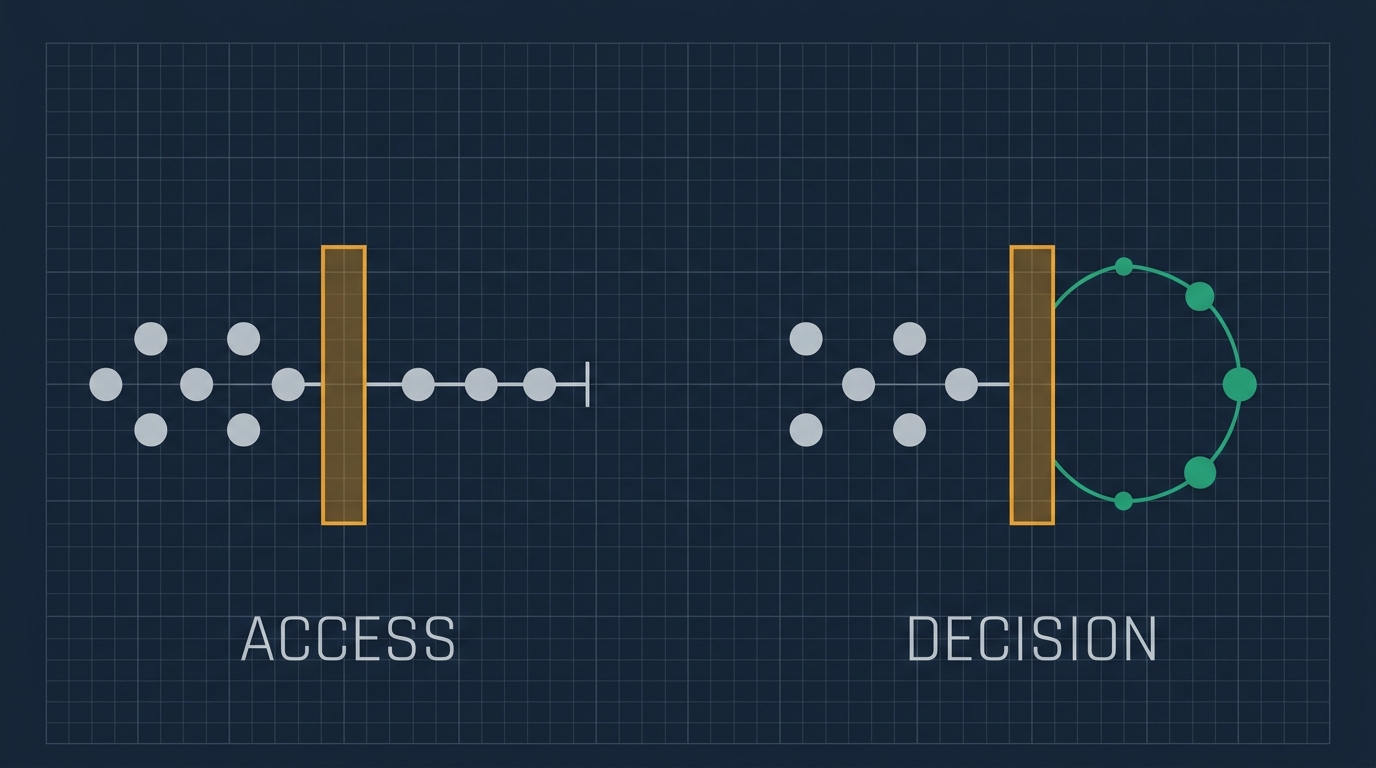
The governance question that matters is not whether a machine may open a file. It is whether the machine may decide, and what it must have learned before it decides again. The industry has spent two years building excellent answers to the first question, and the reason is structural. The systems it was built for cannot learn from their own use, so there is nothing to hold them to.
This article traces where the other answer comes from. It runs from a research architecture in Reykjavik in 2013, through a governance method applied in large organizations from 2016, to what we are building now.
Reykjavik, 2013
At Reykjavik University and the Icelandic Institute for Intelligent Machines, Eric Nivel and Kristinn R. Thorisson built AERA, the Auto-catalytic Endogenous Reflective Architecture, and the Replicode language it runs on. The work was funded by the European Union under HUMANOBS, FP7 grant 231453, between 2009 and 2012. The demonstration system learned multimodal dialogue by observing people, starting from a small ontology and a handful of top-level goals.
Four ideas landed there, implemented rather than proposed, a decade before agent governance became a category.
| Idea | Where it appears | |---|---| | Resource limits govern reasoning itself, not only execution | Steunebrink, Koutnik, Thorisson, Nivel, and Schmidhuber, LNAI 7999, 2013 | | Autonomy is bounded by construction, operating within limits imposed by its designers | Nivel, Thorisson, Steunebrink et al., Bounded Seed-AGI, AGI-14, 2014 | | Purpose is a machine-readable seed, and an ontology is the substrate it reasons over | Nivel and Thorisson, AGI-13, Beijing, 2013 | | A model earns the right to be acted on through measured predictive success | Nivel and Thorisson, Replicode, RUTR-SCS13001, 2013 |
The fourth is the one worth pausing on. In Replicode, the executive monitors the execution of models and updates their success rates accordingly, and given limited resources, only the paths consisting of the best models are followed. A model that predicts well is followed more often. A model that predicts badly loses its claim on the system's attention.
That is authority allocated by demonstrated competence, running in a real architecture in 2013. It is not a governance framework. It is a scheduler. It is also the same mechanism, and the AI governance field has not yet caught up with it.
A Beer Garden in Berlin
I met Eric Nivel in Berlin. He described his entropy metrics for machines operating under resource limits, and I recognized something I had been teaching managers for two decades. I went and read the papers.
What came out of that was not a theory. It was an engineering principle, which I call Tebiki: purpose, values, and constraints, measured by entropy. Picture three sets. The healthy zone is their intersection. Entropy is the measured distance from it.
The definition does real work. A decision that achieves its purpose while violating the organization's values is not merely a poor decision. It is an entropy event, and it is computable rather than debatable. That distinction is why this became an instrument I could apply, in large organizations, on three continents, across several industries, with real teams, rather than a framework I could only publish.
From 2016 that was the Entropositive governance model. In 2019 it gained the piece that matters most here. Authority follows demonstrated competence. Not headcount, not seniority, and not a vote.
Then the Language Models Arrived
A large language model is a statistical model that cannot learn from its own use. It is trained, it is frozen, and it is deployed. Ten thousand hours of production experience change it in no way whatsoever.
My reading at the time, and the bet this company is built on, is that the LLM is a step and a means toward real AI rather than the destination. If that is right, then the learning has to be architectural, because it is absent from the substrate. The model is rented. The experience is owned.
2024 to 2026, the Field Converges
The industry arrived at the parity idea independently, repeatedly, and before us in published form. That is worth naming plainly rather than being shown it later.
Lattice gave digital workers employee records in July 2024, and withdrew the announcement three days later after a backlash. Workday made its Agent System of Record generally available in February 2025. Peerdom put it in one clean sentence in September 2025: the role itself is unremarkable, it could be held by a person, and the governance is identical either way. Microsoft Entra made it a blog title in July 2026. SAP fused it with EU AI Act positioning in June 2026. Okta, CyberArk, 1Password, SailPoint, and Saviynt now treat it as settled category language.
The standards bodies were there earlier still. ISO/IEC 38507:2022, clause 6.3, already held that a governing body remains accountable for delegated machine decisions in the same manner as for human decisions and work.
So the idea that humans and machines belong under one regime is not ours, and we do not claim it. What is worth examining is the shape the idea took.
Access Governance and Decision Governance
Almost all of that work governs what an agent may access. Identity, credentials, delegation, scoped tokens, least privilege, and revocation. This is mature engineering, it is genuinely necessary, and the identity industry is very good at it.
Almost none of it governs what an agent may decide. When it must consult a domain it is about to affect. When it must escalate rather than proceed. What weight its judgment carries on a question, given its record on that question.
One obligation appears to be absent from the field entirely: a requirement that an agent prove it incorporated a prior failure before it may act again.
That absence is not an industry oversight. It follows from the substrate. There is nothing to enforce a learning obligation against when the model is frozen and the agent is a prompt with a role name attached. You cannot require a system to have learned from Tuesday if it is architecturally incapable of being different on Wednesday. The field is not solving the problem badly. It is solving a smaller problem, correctly, because the smaller problem is the one its systems present.
What We Are Building
QAPAF is not a software factory with governance attached. It is a self-learning system whose application domain is software construction, with QAPPA as the AI Persona interface where the two kinds of mind meet.
The structural parallel to AERA is exact. AERA learned conversation by observing people, but it was never a conversation system that happens to learn. It was a learning architecture demonstrated in a conversation domain. QAPAF is a learning architecture demonstrated in a software construction domain.
The mechanism is a decision record. A role states what it decided, why, whom it consulted, which rules it held, what prior experience it drew on, and a falsifiable prediction with a deadline. Later, that prediction is checked. The judgment is deliberately two-part: whether the outcome was right, and whether it was right for the reason the role gave. A role that predicted correctly for the wrong reason got lucky, and luck must never be promoted into a rule.
Two statements of status, because an article that blurs them is not worth reading.
| Element | Status today | |---|---| | The decision record, the falsifiable prediction, and reconciliation | Specified in detail, in build, not shipped | | The measurement that produced the specification | Complete, against live production systems | | The surrounding platform, roles, and knowledge bases | Running |
One design decision is worth stating, because it is the whole point. A human decision and a machine decision produce the same record, in the same store, under the same reconciliation. A human who resolves an escalation states a prediction and is measured against it exactly as an agent is. That is uncomfortable, and it is the point at which parity stops being rhetoric. Humans, like agents, have the right to fail. Neither has the right not to learn.
The Obvious Objection, and the Answer
Competence is incoherent for a stochastic system. Models drift, benchmarks are contaminated, and a capability measured in March may be gone by June. Granting authority on the basis of measured competence means granting it against a number that will not hold.
Every part of that is true, and all of it is an argument for the mechanism rather than against it.
Under 14 CFR 61.57, a pilot may not act as pilot in command unless they have made three takeoffs and three landings in the preceding ninety days. Authority expires on a clock, automatically, with no hearing. The Joint Commission requires ongoing professional practice evaluation of licensed practitioners, feeding a decision to maintain, revise, or revoke existing privileges.
Nobody argues that type ratings are incoherent because pilots get rusty. The instability is precisely why currency requirements exist.
Human governance already binds, proves, and revokes in high-consequence domains. It simply does so at low resolution, high latency, and high cost. A practitioner's privileges are reviewed on a periodic cycle, over sampled records, by people who have other work. For a machine it can be every action, continuously, at almost no marginal cost.
The difference between governing people and governing machines is one of degree, not of kind. That is the claim, and it is the one this thirteen-year line of work supports.
What Would Falsify This
The honest position is that the core bet is untested rather than proven. Nobody has published evidence either way that a decision and reconciliation loop improves an autonomous engineering system.
So the first milestone is not a shipped product. It is one role that made a decision, stated a prediction, was reconciled against it, and demonstrably did something different next time as a result. If that does not produce better decisions than the same role without it, the premise is wrong, and we will say so.
That is the experiment. Everything else is the apparatus for running it honestly.