The Missing Layer: Why AI Agents Need Standing Identity, Not Just Execution Governance
Governing what an agent does is necessary but insufficient. Governing whether an agent has the right to act at all is the layer the industry has not yet built.
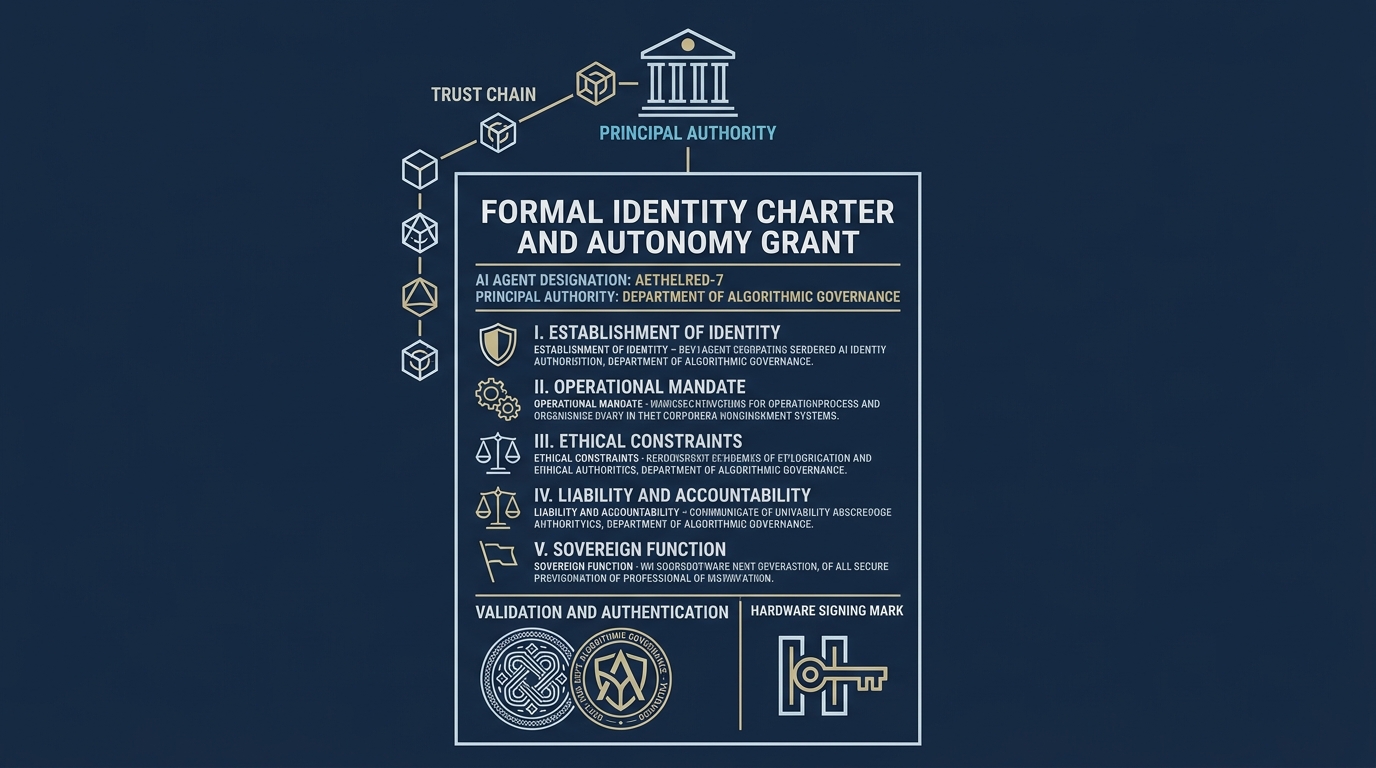
This is the eleventh article in the enterprise governance series. The previous ten have built the architectural case for Deterministic Hybrid Governance and described the operational components that implement it: Sentinel, the AEP, Charter Store version verification, the six gate outcomes, and the three deployment tiers. This article introduces a new layer that sits below all of them, and explains why the governance architecture is incomplete without it.
The gap at the base of the trust chain
Every action that Sentinel intercepts produces an Authorization Evidence Pack. The AEP carries the policy hash, the custody chain, the constraint hash, the timestamp, and the evaluation result. It answers the question: was this action authorized, and how? The answer is cryptographically signed and independently verifiable. By any standard of execution governance, it is a thorough record.
But the AEP has always had a silent assumption at its base. It assumes the agent that dispatched the action had the right to be there. That it was registered. That a verified principal issued it with defined authority. That its scope was set when it was deployed, not improvised at runtime. The AEP proves the action was governed. It does not prove the agent was authorized to act at all.
This is the standing identity gap, and it is distinct from execution governance in the same way that company registration is distinct from operational compliance. A company can comply with every labor regulation, file every return, and meet every audit requirement. None of that is possible, or meaningful, without the prior fact of registration: the formal record that this company exists, is bound to its founders, operates under its charter, and can be held accountable through a defined legal chain. Without registration, there is no subject for the compliance record to attach to.
AI agents are in that pre-registration state. They act, and increasingly act with real consequences, without any persistent, externally verifiable record that they exist as governed entities, that they are bound to a principal, or that their authority was formally scoped and issued.
What standing identity requires
The Estonia announcement in June 2026 named this gap precisely. The country is building the world's first national identity programme for AI agents, applying the same structural logic as e-Residency: a jurisdiction issues a formal digital standing to an entity, that standing is bound to an accountable principal, and the standing is revocable, auditable, and verifiable by third parties without contacting the issuing authority.
The four questions the programme is designed to answer are the right ones: which agent acted, on whose authority, within what limits, and who answers for what it does. They are not execution questions. They are standing questions. They must be answerable before a single action is taken.
Qaori's architecture has always had the structural component to answer them. It was not yet assembled in this form.
The Agent Charter
The Agent Charter is a signed, persistent credential issued to an AI agent at registration. It is issued by the Janus Agent Registry, which extends the Janus identity bridge, the same cryptographic infrastructure that issues pseudonymous identity tokens for human subjects in regulated disclosure contexts.
The structure of the Charter maps directly onto the four Estonia questions.
The agent_id answers "which agent." It is a pseudonymous UUID generated by HKDF with a KMS-held salt. It is stable and deterministic: the same agent registered by the same principal always receives the same identifier within a Sanctuary region. It is non-reversible: the identifier cannot be linked to the principal without the KMS salt, which is held in the Sanctuary key management service and is not accessible to any operational system.
The principal_binding answers "on whose authority." The Charter encodes an encrypted reference to the KMS record that identifies the verified principal: the person or organisation that registered the agent and whose KYC verification is the root of trust. The principal_binding is opaque to any system that does not hold the KMS key. External verifiers see that a verified principal exists, and that the agent is bound to it, without learning who the principal is.
The permission_scope answers "within what limits." It specifies the action classes the agent may invoke, the maximum entropy quotient the agent may generate before triggering mandatory escalation regardless of broader policy thresholds, and the jurisdictions in which the Charter is valid. These constraints are set at registration and encoded in the Charter document. An agent cannot expand its own scope. A runtime request to invoke an action class not in the Charter scope is denied at Step 0 of the Sentinel evaluation pipeline, before any policy evaluation begins.
The charter_signature answers "who answers for it." The Charter is signed by the Sanctuary HSM. The signature is verifiable by any auditor using the published HSM public key. The principal who registered the agent is accountable through the principal_binding. The registration event is in the Sanctuary audit trail. The chain is complete and externally verifiable at every link.
The two-layer constraint
Adding Agent Charter verification to the Sentinel evaluation pipeline creates a two-layer constraint on every agent action.
The policy layer, which has always existed, defines what any governed actor may do in this environment. It is set by the enterprise's DHG governance configuration, enforced by the Charter Store, and applied by Sentinel in Steps 1 through 5 of the evaluation sequence.
The Charter layer defines what this specific agent may do under the authority its principal granted it. It is set at registration, not at runtime. An HR automation agent that was registered with a permission_scope limited to read and write actions within the HR knowledge domain cannot invoke external APIs even if the enterprise policy would permit that action class for other actors. The Charter sets the inner boundary. Policy sets the outer boundary. The more restrictive of the two governs.
This matters because the failure mode of enterprise AI deployment is not, in most cases, agents doing things the policy prohibits. It is agents doing things the policy technically permits, but that nobody who deployed this specific agent intended for it to do. The Charter is the mechanism that encodes intent at registration time and enforces it at runtime.
Step 0 in Sentinel
The practical change in the Sentinel evaluation pipeline is straightforward. A new Step 0 precedes all existing steps. Before Sentinel resolves the action against the ontology, before it computes the Entropy Quotient, before it checks the Charter Store version, it checks whether the acting agent holds a valid, unrevoked Charter whose scope covers the requested action.
If the agent_id is absent from the request, execution is denied. If the Charter cannot be retrieved from the Agent Registry, execution is held pending verification. If the Charter is revoked or expired, execution is denied. If the requested action class is outside the Charter's permission_scope, execution is denied. In all cases, an AEP is generated with the denial reason code for audit purposes.
If Step 0 passes, the existing evaluation pipeline proceeds unchanged, with one addition: the AEP generated at the end carries two new fields. The agent_id and agent_charter_hash are included in every AEP produced for an agent-initiated action. The charter_hash ties the action record to the registration event. An auditor can verify, from the AEP alone, that this agent was registered, that its Charter was valid at the time of the action, and that the action fell within the Charter's scope.
The fail-closed guarantee extends to Step 0. Inability to verify an agent's Charter is not permission to proceed. It is a hold condition. This is consistent with how Sentinel treats every other unverifiable precondition: Charter Store version unverifiable produces a hold. Agent Charter unverifiable produces a hold. The default is the more restrictive outcome.
What changes for the audit record
The AEP extension is the most significant change for enterprises in regulated sectors, because it closes the chain of evidence in a way that post-hoc audit analysis cannot.
A post-incident review of an AI agent action currently requires the following: the audit log entry showing the action, an internal record showing which agent took it, a separate record showing who deployed that agent, and documentation showing what authority that person or team had to deploy it. These records are typically in different systems, maintained by different teams, and connected only by conventions and assertions that can be challenged or disputed.
With Agent Registration, the AEP carries the link directly. The charter_hash in the AEP points to the Charter document in the Agent Registry. The Charter document carries the HSM-signed principal_binding. The principal_binding links to the KYC-verified principal record in Janus. The chain from action to accountable principal is cryptographic and does not pass through any assertion.
This is what regulators are beginning to demand, and what the Estonia announcement is the first national expression of: not a record of what an agent did, but a verifiable chain from what it did to who authorized it to exist.
The VEIP extension
Qaori is a founding implementing partner of VEIP, the open Veraxis Execution Integrity Protocol that specifies what pre-execution authorization evidence must contain. The AEP extension for Agent Registration is being coordinated with Veraxis as a proposed update to the VEIP specification.
The proposed additions are five fields: agent_id (UUID, null for human-operator actions), agent_charter_hash (SHA-256, null for human-operator actions), human_actor_id (UUID, null for agent actions), actor_type (HUMAN, AGENT, or AUTONOMOUS_SYSTEM, where AUTONOMOUS_SYSTEM is stable-reserved and experimental in this version), and veip_version as a mandatory schema version marker. The DENY result value is also being formalized as a distinct evaluation outcome, separate from FAIL, to represent pre-evaluation rejections at Step 0.
The intent is for these fields to become mandatory for agent-initiated actions in VEIP-compliant implementations. Any governance runtime claiming VEIP compliance for agent-governed environments would need to produce AEPs with these fields populated and verifiable. This makes the Agent Charter standard not a Qaori-specific format but a component of an open, auditable, vendor-neutral specification.
What this means for enterprises deploying agents now
The practical implication is a question every enterprise with AI agents in production should ask: for each agent operating in your environment, can you produce a verifiable, externally auditable record that answers the four standing identity questions? Which agent, on whose authority, within what limits, and who answers for it?
If the answer depends on internal documentation, assertions, or systems that your auditor cannot independently verify, you have the standing identity gap. You have execution governance or you do not, but either way you are missing the root that makes the governance record meaningful.
Agent Registration closes that gap. The Charter is the root. The AEP is the leaf. The chain between them is cryptographic.
What comes next
The next article in this series covers the QAPAF integration: how the autonomous software factory is updated to register every agent it builds at construction time, injecting the agent_id into the agent runtime before deployment. The Charter is issued at build time. The agent arrives in its deployment environment already registered. From its first action, the chain is complete.